How I am using AI, nearly two years later
Coming back to my website nearly two years later and looking at how AI has become part of my work and personal life.
August 21, 2026
It has been nearly two years since I wrote anything here, which I didn't realise until I started revamping the website and had to read the old posts again.
Reading them back has been a bit painful. There's nothing particularly terrible in them, but I can see lots of things I would write differently now, and apparently I was very enthusiastic about exclamation marks. I also described GitHub as an architect's office and Vercel as an estate agent, which felt helpful at the time.
I don't want to delete them though. They are an honest record of what I knew when I started this little project, which was not very much, and I still like that I made something and put it online rather than waiting until I understood everything properly. Reading them now also lets me compare where AI was then with how I am using it today.
In my post about building the website, I wrote:
I can see how we will soon have ‘AI analysts’ as mini team members to create and edit slides, analyse and present data etc. and that is exciting!
I had forgotten about that sentence. I am working on a project largely by myself and have started using Claude as a sort of analyst in my team, so I was not too far off.
What has changed since I built the website?
The first version of this website took me weeks to build. I was travelling at the time and it was deliberately a project to keep me busy and help me learn something new, so I didn't mind that. I used Cursor, ChatGPT, Gemini, Google and a lot of YouTube. I got stuck on tiny errors, tried to understand what every file did and kept a Google Doc of basic tips and commands because I could never remember them.
After trying lots of different things, I deleted most of them and published the simple pink page below.

The original homepage, built in 2024 with a lot of help from Cursor, ChatGPT, Google and YouTube.
This time, I revamped the website in about an hour using Codex. The website already existed and I understand more than I did in 2024, so I was not starting from the same place. I was still surprised by how quickly I could change it. I described what I wanted the site to look and feel like, Codex looked through the existing code and made the changes. I could review them in the browser and ask it to adjust anything that wasn't quite right.
When I first built the website, AI was mainly explaining what I needed to do and I was then making the changes (often with a lot of back and forth when something didn't work). This time it could work directly on the website with me. I now use AI for questions and as part of quite a few normal routines too.
What do I use it for outside work?
From a personal perspective, I use ChatGPT for almost everything that I used to Google. This includes travel questions, recipes, recommendations, explanations, how to fix something and lots of very random things that occur to me during the day.
I still use Google when I know which website I am looking for or when I want to check the source of something. If I want to understand a topic or compare a few options, I find it much easier to use ChatGPT than open lots of tabs and piece the answer together myself.
I have also set up a couple of scheduled tasks for Monday mornings. One is a job alert based on criteria I have given it. I'm not actively applying for jobs, but I think it is useful to know what is out there, which roles sound interesting and what companies are looking for. It means I get a view of the market without having to remember to search several job sites every week.
The other is a telecoms, media and technology (TMT) industry briefing. This gives me a summary of developments in the industry I work in and anything interesting I might need to stay on top of for work. I could search for all of this myself, but in practice I wouldn't do it every Monday morning. The scheduled task means I actually read it every week.
My recent chat history gives a more honest view of how I use it day to day. It is a mixture of useful questions, life admin, things I am curious about and plenty of things that I could have Googled.
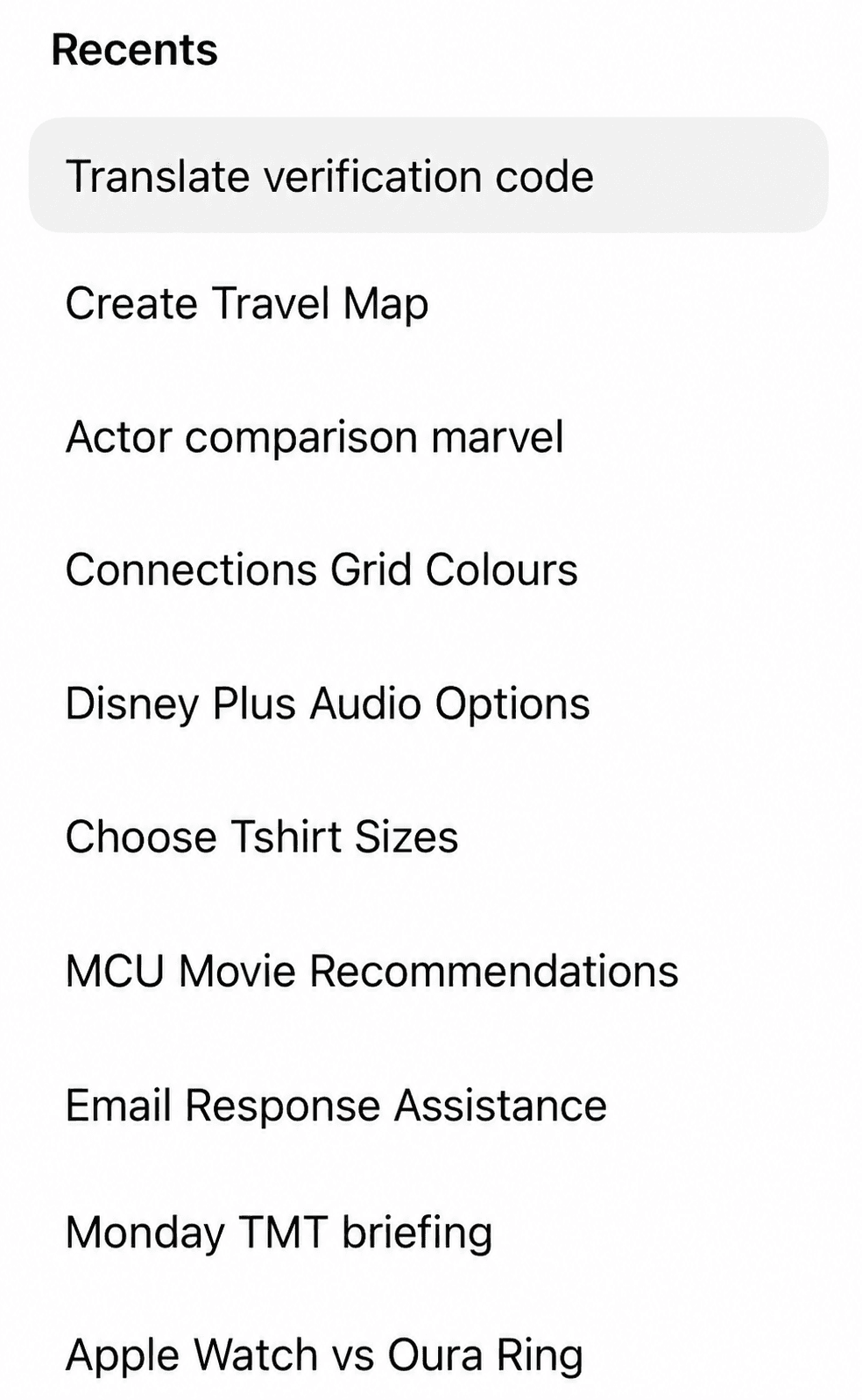
A fairly accurate cross-section of what I ask ChatGPT about.
How am I using it at work?
At work, I mostly use Copilot and Claude. At the moment, Friday is a non-working day for me, so one of my first jobs on a Monday is working out what happened at the end of the previous week. I have saved a prompt that I use to catch up on Friday's emails, messages and documents. It gives me a starting point and means I don't have to spend the first hour of Monday searching through everything myself.
I use Copilot regularly for meeting notes too. I have saved prompts with the format and style that I like, which I use to turn a transcript into the key points, decisions and actions. I always review the output because Copilot can get names wrong, miss important context or give too much weight to something that took up time in the meeting but was not important afterwards.
I'm still a bit torn on how to share these notes with other people. Do I call them my takeaways and include the AI-generated notes separately, or say nothing because people assume AI was involved anyway? Once I have reviewed and corrected them, I think they are still my output, but I haven't worked out where I land on this yet. It may be one of those awkward things we are all working through while the tools become more normal.
Copilot is also useful for finding things across the company network. I use it to search for examples of work that already exists, find a slide that I can picture but cannot locate and search my emails because normal email search is still terrible. I use this all the time because so much existing work and knowledge can otherwise be difficult to find.
I have played around with setting up an agent as well without having a good use case for it, and I didn't get much value from it. I mainly wanted to try an agent without having a specific problem for it to solve, which was probably the issue!
Claude as my project analyst
Claude is what I use most for progressing my project work, and I have started to think about it as an analyst that I can ask to help with parts of the work.
This week I used it for Excel modelling for the first time and it was amazing. When I was a junior commercial analyst at Vodafone and Virgin Media, I remember doing so much of this manually. I would Google a formula, watch a YouTube video, work out how to set up one part of the model and then spend ages trying to find out why something didn't work.
Claude can now do some of that in five or ten minutes. It can help set up the analysis, draw out conclusions and suggest other ways to look at the data. I have also asked it to help me work out whether differences in the data are statistically significant, which is not something I have done regularly for a long time.
I have to be a bit careful about letting it keep going. It will suggest more and more analysis, including things like t-tests that may be interesting but are not needed for the question I am trying to answer. I still need to know what I am looking for and have enough understanding to notice when it has gone down a rabbit hole. Otherwise, I can end up with ten extra analyses that don't help me answer the question.
I have also been using Claude for PowerPoint. I am producing toolkits that are around 40 or 50 slides long. It can go through the pack and change all of the headings into a consistent format, adjust the tone for the audience and pick out inconsistencies between pages. This is the type of thing I was imagining when I wrote about AI analysts in 2024.
It doesn't get everything right. At the moment it seems to remove comments from PowerPoint files, which is a problem, and it has deleted content from slides before when I gave it permission to make changes. I still need to review every page after it has finished. I would do that if an analyst had made the changes too, although an analyst would hopefully not quietly remove all of my comments!
I have found that I get better results when I treat it a bit like someone working with me. I need to explain the audience, what I am trying to achieve and what it should or should not change. The broad instructions I have tried on a 50-page deck have given it too much scope to change the wrong thing.
We are also hiring in the team at the moment, so I have used it to help with interview preparation. I can give it the criteria we are assessing and the case study we are using, then ask it to suggest questions I might want to explore. Afterwards, it helps me turn my notes into clear and objective feedback for the recruitment team. I still make the assessment, but it makes the preparation and write-up much quicker.
I have also been testing agents and skills in Codex while working on this website. In the last few days, it has helped me turn the list of books I have kept in Notes since 2018 into a bookshelf page, connect my running data to the outside-work page and work on a draft explaining how agent loops work, including a small interactive demo. I got more from those experiments because I had a specific thing I wanted to make each time.
Skills are slightly different. We created a writing style file based on my old posts, which Codex now reads before editing an article, and I installed another skill that checks for the phrases and sentence structures that tend to make writing sound AI-generated. This article has been through both. I like the idea of teaching a tool how I want to work once, although I am still working out what is worth saving as a reusable skill and what is easier to explain each time.
Do I think it is game-changing now?
In 2024, I wrote that I didn't know whether AI was game-changing yet. For some of the work I do, I would probably say yes now.
I notice the difference most on my current project. I can get through work that would previously have taken me much longer, although I also spend time checking what Claude has done and pulling it back from unnecessary analysis.
I don't know whether this means I will start writing here regularly again. Based on the last two years, I probably shouldn't make any promises! I am glad I kept the old posts though. It was funny to find that sentence about AI analysts during the same week that I first used Claude for Excel modelling.